-

Reconnecting with Your Authentic Self Through Ibogaine and Psychedelics
22nd January 2025
22nd January 2025
Reconnecting with Your Authentic Self Through Ibogaine and Psychedelics

Reconnecting with Your Authentic Self Through Ibogaine and Psychedelics
Despite how confidently we present our lives as fulfilling or how often we convince ourselves that we’ve had “happy” childhoods, there’s often a piece missing from the puzzle—our emotional well-being. Many of us evaluate our past based solely on physical needs being met while overlooking emotional scars that may linger. For those seeking deeper emotional healing, reconnecting with your authentic self through ibogaine and psychedelics offers a profoundly transformative approach.
The reality is that every single one of us has experienced some degree of trauma, whether we consciously recognize it. Even those who feel their childhoods were “good” often carry unresolved emotional wounds locked within their subconscious minds. With the help of ibogaine therapy at Iboga Tree Healing House, our centre located in rural Portugal, individuals can unlock those wounds, allowing them to move forward with clarity and self- awareness.
This article explores the journey of reconnecting with your true self, diving into how emotional trauma affects the subconscious, and how plant medicines like ibogaine serve as a bridge toward healing. By the end, you’ll have practical tools to process emotions in real time, helping you reduce reliance on maladaptive coping strategies such as substance abuse or avoidance behaviours.

The Depth of Trauma and How It Shapes Our Lives
Trauma is an unavoidable part of life, taking on many forms—whether emotional, physical,or sexual. Its aftermath often varies in severity, presenting symptoms like anxiety, depression, flashbacks, and addiction. In some cases, trauma can lead to self-harming tendencies, low self-esteem, or PTSD. Yet, many people fail to connect these symptoms to unresolved emotional wounds buried in their subconscious minds.
Therapeutic approaches like reconnecting with your authentic self through ibogaine and psychedelics have shown remarkable potential in uncovering and addressing these hidden traumas. Unlike traditional talk therapy, ibogaine therapy works directly with the subconscious, peeling back layers of suppressed memories and emotions. During an ibogaine journey, individuals often experience vivid, dream-like visions that reveal insights about past events—many of which were long forgotten but still impact present-day behaviour.

The Role of Dissociation in Emotional Survival
Dissociation is a protective mechanism the brain uses to shield us from overwhelming emotional pain. It can manifest in subtle ways, like zoning out during stressful situations, or more extreme forms, such as developing alternate identities or disconnecting from reality altogether. For many, dissociation becomes a go-to survival tactic during childhood trauma when there are no safe outlets for their emotions.
However, dissociation comes at a cost. By separating from painful emotional experiences, we lose touch with parts of ourselves. This disconnection can lead to addiction, avoidance, and a lack of emotional intimacy in adulthood. That’s where reconnecting with your authentic self through ibogaine and psychedelics becomes invaluable. These plant medicines enable individuals to confront dissociated emotions, offering a safe space to reintegrate and process them fully.
Through this deep inner work, clients at Iboga Tree Healing House often report profound breakthroughs in understanding their behaviours and emotional responses, paving the way for healthier patterns and renewed connections with themselves as they seek to heal from conditions as diverse as PTSD, depression, chronic anxiety, behavioural addictions, as well as substance addictions.
The Subconscious Mind as a Warehouse of Limiting Self-Beliefs
Our subconscious mind is an incredibly powerful tool, storing memories, emotions, and beliefs that shape how we navigate the world. While the conscious mind focuses on rational thoughts and problem-solving, the subconscious operates beneath the surface, automating processes like breathing, digestion, and even habitual behaviours.
Unfortunately, the subconscious also serves as the keeper of unresolved trauma. Childhood experiences, especially those that involved emotional invalidation or neglect, leave lasting imprints. For instance, a child frequently dismissed as “too emotional” may grow up internalizing the belief that their feelings are unimportant or unwelcome. These subconscious beliefs then dictate their adult relationships, often resulting in emotional disconnection or dysfunction.
One of the most transformative aspects of reconnecting with your authentic self through ibogaine and psychedelics is the ability to access the subconscious mind directly. During ibogaine therapy, individuals gain clarity on the core beliefs and memories that drive their behaviours, creating space for healing and self-compassion.

How Trauma Becomes Suppressed in the Mind
When we face intense emotional or physical stress, the brain often pushes painful memories into the subconscious as a way to cope. This suppression helps us survive in the short term, but over time, these buried memories can cause emotional distress, anxiety, or even physical ailments.
For example, a child who is repeatedly told to “stop crying” may learn to suppress sadness entirely. As an adult, this individual might feel inexplicably triggered and reactive by situations where they perceive emotional invalidation or gaslighting in the present moment, even without understanding the connection to their childhood experiences. This unprocessed trauma can manifest as heightened sensitivity, anger, or withdrawal.
Reconnecting with your authentic self through ibogaine and psychedelics allows these suppressed memories to resurface in a safe and controlled environment. At Iboga Tree Healing House, clients often report experiencing vivid emotional and sensory recall of past events during their ibogaine sessions. This process not only helps release stored trauma but also provides valuable insights into the origins of behaviours like addiction or emotional detachment.
The Cost of Rejecting Parts of Ourselves
As children, we are naturally whole and authentic. However, to survive in environments where certain emotions or behaviours are deemed “unacceptable,” we learn to suppress parts of ourselves. For example, a child who senses that anger is frowned upon may suppress this emotion entirely, leading to internalized shame or self-hate later in life.
The act of rejecting parts of ourselves creates a lifelong struggle with self-acceptance. Many of us grow up feeling disconnected from our true selves, which leads to anxiety, low self- worth, and difficulty trusting our instincts. Reconnecting with your authentic self through ibogaine and psychedelics offers a way to mend this internal split. By embracing the parts of ourselves we’ve long rejected, we can nurture self-acceptance and emotional healing.

A Step-by-Step Guide to Processing Emotions in Real-Time
Understanding Emotional Processing
Emotions act as a guide, offering valuable feedback about our internal states and external circumstances. However, society often teaches us to suppress or distract ourselves from difficult emotions, which only traps them within our bodies and minds. The good news is that emotions are naturally designed to flow if we allow them to.
This process will teach you how to unconditionally be with whatever challenging feeling you would usually run from. Instead of seeing your emotional pain as something that is trying to harm you, why not view it instead as an important messenger crying out for your attention? It’s almost as if it were a small child who needs comforting and validation from a wise adult.
By engaging in this process, you will essentially be running towards your emotional discomfort instead of away from it, setting yourself up to receive the message it has to deliver.
Over time, as you turn this into a regular practice—and it will take persistence and repetition—you will likely find that you no longer feel the need to try to distract from, numb, fix, dissociate from or self-medicate to deal with your emotions. Remember: emotions only frighten us because we have been conditioned to avoid them.
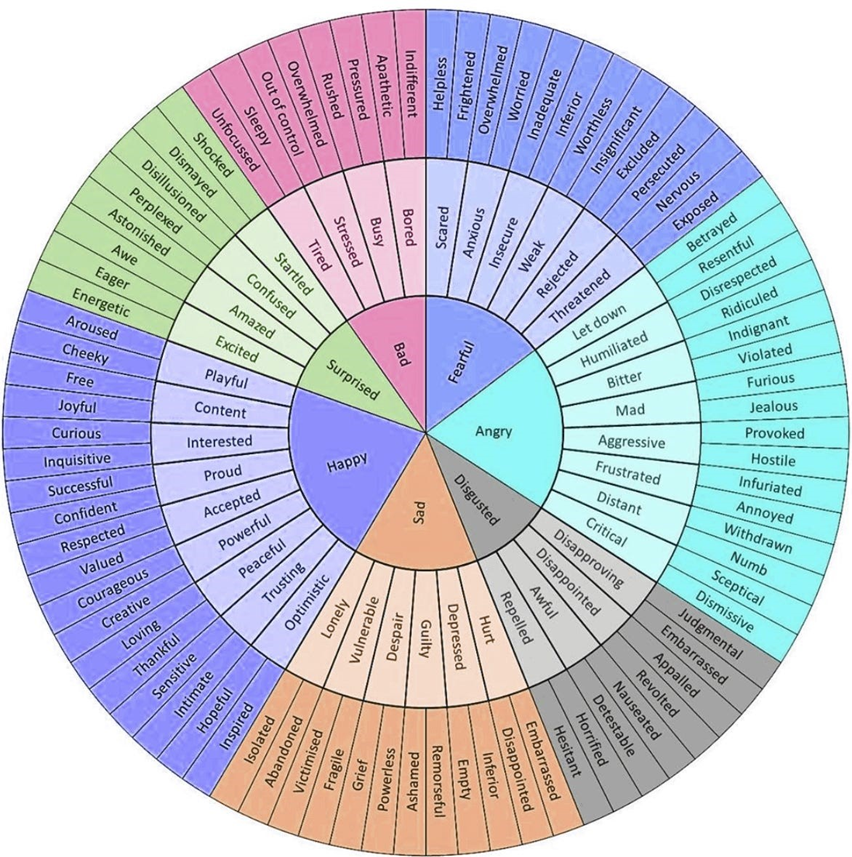
To help you identify or name emotional states, you may use the “Feelings Wheel” included below; you will surely find it invaluable in helping you identify what you are feeling in any given situation.
How to Do the Emotional Processing Technique
1. Create a Safe Space: Use the feelings wheel to identify what emotion you are experiencing in the moment. It would be a good idea to save it as a PDF on your phone so that you always have it with you. Find a quiet, distraction-free environment where you can focus inward. Lie down or sit, close your eyes, and turn your attention inward. You can either do this in silence or put on very low, soothing music.
2. Tune Into Physical Sensations: Begin by taking a few long, deep breaths for a few minutes. Mentally scan your body from the top of your head to your toes, noticing where in your body you feel any kind of unpleasantness. Is it a heaviness in your chest? A tightness in your stomach? Tingling in your arms or legs? It may take you some time to locate where in your body the tension is. Be patient with it, as all of this will likely be new to you.
3. Avoid Judging or Resisting: Let the emotion exist without trying to fix it or push it away. Should you encounter any mental narratives, such as “I can’t do this,” or that this exercise is pointless, remind yourself that these thoughts are reflections of the hopelessness you felt as a child when you first encountered this emotion and were invalidated, not learning how to process it.
4. Ask Yourself Questions: Anchor your attention by asking, “What does this feel like?” Try to focus on any feelings that arise by asking yourself if there is any sound, taste, texture, smell, or image that comes up. Remember, you are not looking for a mental story about the feeling (e.g., “I feel worthless” or “I’ll never finish this project in time for the deadline.”). Instead, you are looking for descriptive sensations like, “this feels heavy” or “I see the color red.” After each new sensory “package” or “download” appears (as we like to call it here at Iboga Tree Healing House), repeat the question to it, always anchoring yourself in the five senses as you feel for a response. If mental stories about the feeling arise, let them appear, but then refocus on your work.
5. Witness the Emotion’s Journey: Allow the emotion to evolve naturally. It might shift in intensity or transform into another feeling entirely; for example, anger might transform into sadness. Know that this is normal and expected within this process. Should you experience any powerful emotional reactions, like shaking or uncontrollable crying, let them flow and don’t suppress them—this is what it feels like when your body clears itself of stored trauma.
6. Address Resistance with Compassion: If you find yourself continually resisting the process, treat that resistance as part of the journey. Use the anchor question, “What does this resistance feel like?” Do not berate yourself for it. Resistance is often a protective layer, especially when it comes to severe trauma. If you instinctively feel that there is something hidden underneath the present emotion, ask yourself to feel it by saying, “What is underneath this fear? Is there anything more painful there?” However, do not force yourself to go deeper. Truly ask yourself if you are ready to dive deeper. This will empower you to give yourself a choice, which you may not have had when a specific traumatic event occurred. If this is the case, stay with whatever emotion you are currently working with.
7. Let the Emotion Release: Emotions will dissipate on their own when fully felt, and this usually won’t take long. The reason we aren’t aware of this—and often think that giving an emotion attention will make it intensify—is precisely because we are too quick to reach for a behavioural distraction or a substance whenever we experience an uncomfortable emotion. This is why it is important to stay present with the process until the intensity naturally subsides.
8. Integrate What You’ve Learned: Afterward, reflect on any insights that arose. These revelations can guide your personal growth. We encourage you to spend some time journaling about what came up for you.
Essentially, this process is the closest thing to experiencing a plant medicine journey like ibogaine, ayahuasca, or psilocybin: you are simply lying down and focusing on the messages your body and subconscious are bringing up for you. This is why it is essential as a mindfulness practice after ibogaine therapy, and you would benefit greatly from making it a regular practice in your day-to-day life. By practicing these steps regularly, you’ll build emotional resilience and reduce your reliance on maladaptive coping mechanisms.
Why This Journey Matters
The path to self-discovery is not always easy, but the rewards are profound. At Iboga Tree Healing House, the combination of plant medicine therapies and holistic aftercare offers clients an unparalleled opportunity for growth. Reconnecting with your authentic self through ibogaine and psychedelics enables you to shed layers of emotional pain, reconnect with your
innate wholeness, and move forward with a renewed sense of purpose. Healing emotional wounds and rediscovering your true self requires courage, patience, and the right tools, which is why reconnecting with your authentic self through ibogaine and psychedelics offers a path toward profound transformation. Whether you’re dealing with addiction, emotional pain, or a sense of disconnection, plant medicine therapies provide a way to access and heal the root causes of these struggles. To learn more about the healing work we do at Iboga Tree Healing House, don’t hesitate to reach out. Their experienced team is ready to guide you toward a brighter, more authentic future.

